
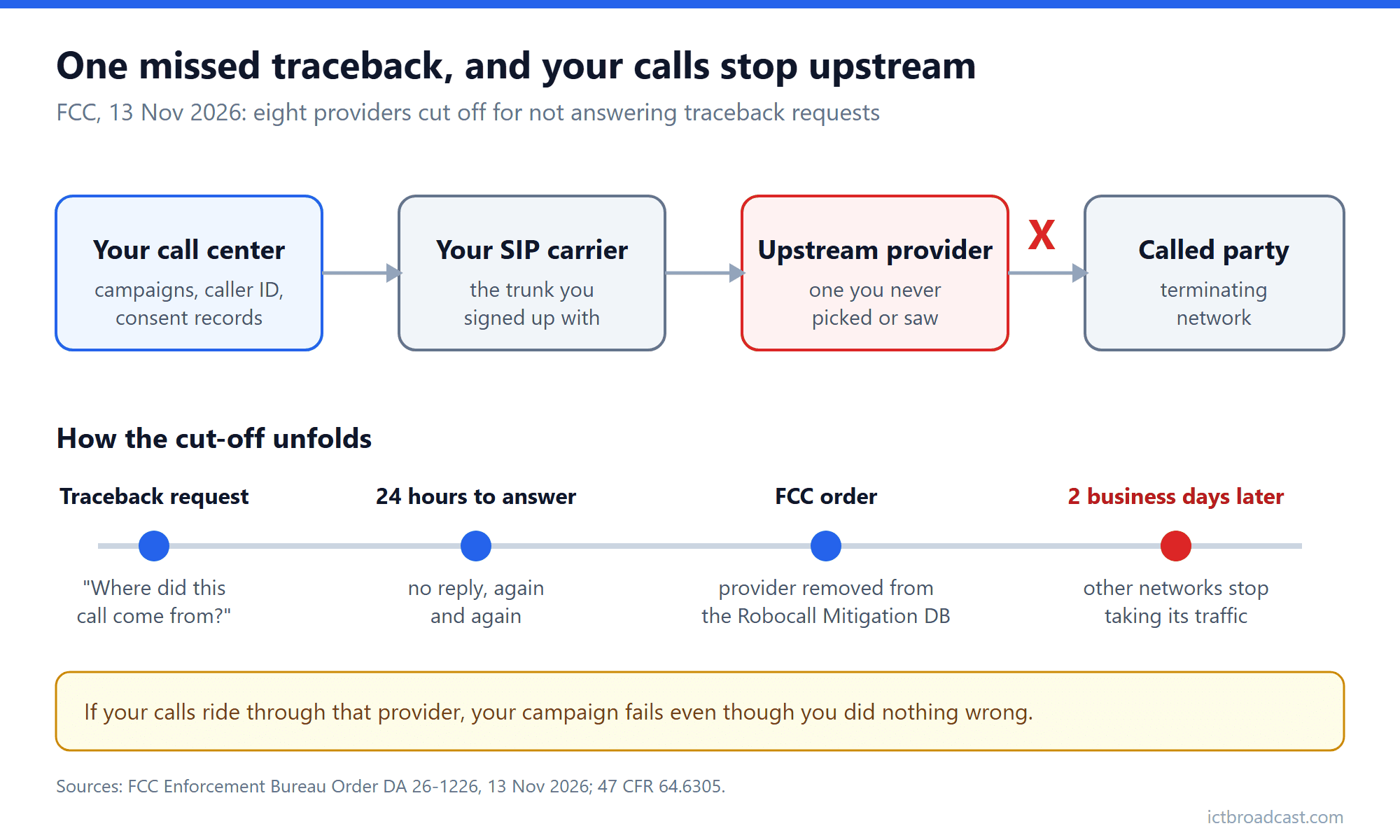
On 13 November 2026 the FCC removed eight voice providers from the Robocall Mitigation Database because they ignored traceback requests. Every other carrier now has two business days to stop taking their calls. If your call center software sends traffic through one of them, even several hops upstream, your campaigns stop too, and you didn’t do anything wrong.
That’s the part of robocall enforcement most outbound teams never plan for. You picked a carrier, you signed a contract, the trunk registered and the calls went out. What you probably didn’t pick is the chain of providers your carrier hands calls to. This order is a reminder that any link in that chain can be cut on very short notice, and that the fastest way to get cut is to go quiet when someone asks where a call came from.
What the FCC ordered on 13 November
The Enforcement Bureau’s order, DA 26-1226, was adopted and released on 13 November. It removes the certifications of eight companies from the Robocall Mitigation Database (RMD): Advantage Investors llc, sunstreamnetwork, Quantum Link VOIP, Summit Industries, Scissortail Communications LLC, Globe Tech Solutions, Alpha Stream and MMN Tech LLC.
The history is short. On 27 August the Bureau sent a show cause order to nine companies, telling each one to fix its RMD filing or explain why it shouldn’t be removed. The eight named this week did neither. According to the order, each had failed to respond to multiple traceback requests from the industry traceback consortium, which contradicts what they’d certified in the database.
Here’s what the order says happens next:
- Removal is immediate. The eight are out of the RMD as of the release date.
- Two business days to stop the traffic. All intermediate providers and voice service providers must stop accepting traffic directly from these companies within two business days of release. The only exceptions are calls to 911 and calls from public safety answering points and government emergency numbers.
- No quick comeback. None of the eight can file again without the consent of both the Wireline Competition Bureau and the Enforcement Bureau.
Why a missed traceback is enough to get cut off
A traceback is the industry’s way of following a suspicious call back through every network it crossed until it reaches the provider that let it in. Each provider in the path gets asked the same question: who handed you this call?
Since 26 February 2024, every provider filing in the RMD has certified, under penalty of perjury, that it will respond to traceback requests from the FCC, law enforcement and the industry traceback consortium within 24 hours. The order spells that out. So ignoring a traceback isn’t a paperwork slip. It makes the provider’s certification inaccurate, and an inaccurate certification is grounds for removal.
For you, the important thing is how that pressure flows downhill. When a traceback lands on your carrier and the call came from your account, your carrier will ask you. If you can’t answer quickly, the carrier has a choice between protecting its own listing and keeping your business. You already know which one it’ll pick.
The states want the database much tighter
Three days before the order, on 10 November, the National Association of Attorneys General sent reply comments to the FCC on behalf of a bipartisan group of 49 attorneys general. They back the FCC’s plan to rebuild the database and want it to go further. Among their asks:
- Verify provider information before a filing shows up in the RMD.
- Require disclosures about related businesses, third-party service providers and company principals.
- Make providers certify that their filings are accurate and that they follow the FCC’s robocall rules.
- Make it harder for removed providers to come back under a new name.
- Keep historical filings and publish provider status for law enforcement and industry oversight.
That lines up with the FCC’s own proposal, which we covered when it hit the Federal Register: it lists dialing platforms and call centers by name as the kinds of entities the rules should reach. None of the proposal is law yet. The direction is clear, though, and this week’s order shows the Bureau is already removing providers under the rules it has today.
Five carrier checks for your call center
None of this needs a lawyer to start. It needs an afternoon and a short list.
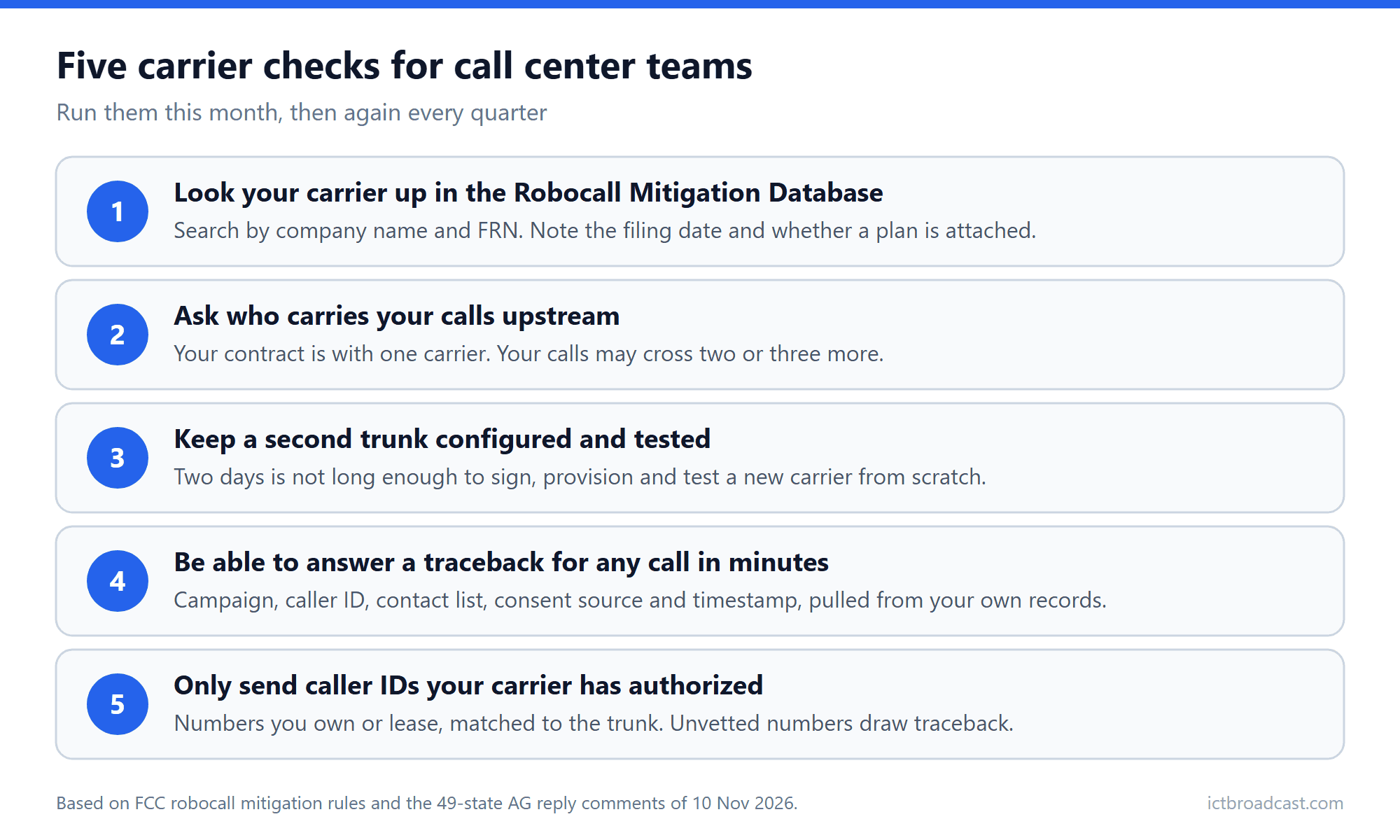
- Look your carrier up in the RMD. Search the public database by company name. Check that a current filing exists and that a robocall mitigation plan is attached. If your carrier isn’t there, nobody else is allowed to take its calls.
- Ask who carries your calls upstream. Your contract is with one company, but your calls may cross two or three more before they reach the person you’re calling. Ask your carrier which providers it uses for your traffic, and check them too. A good carrier will tell you. A vague answer is useful information.
- Keep a second trunk ready. Two business days isn’t long enough to find, sign, provision and test a new carrier from scratch. In ICTBroadcast you can add trunks under Settings > Trunks, so keep a second one registered and run a small test campaign through it every month or so. Then a cut-off becomes a configuration change rather than an outage.
- Be ready to answer a traceback in minutes. When your carrier asks about a call, you want the campaign, the caller ID, the contact list it came from and the consent record for that number, pulled from your own system. Campaign reports and call records in your call center software should get you most of the way there. Write down who answers these requests and how, before the first one arrives.
- Only send caller IDs your carrier has authorized. ICTBroadcast’s own setup guide says it plainly: the caller ID on a campaign must be a number registered with your SIP trunk provider. Numbers you don’t control are the quickest route to a traceback, and to the “Spam Likely” label that follows.
One more habit is worth adding. Keep your Do Not Call lists and opt-outs clean. ICTBroadcast checks campaigns against master and user DNC lists before it dials, and a list that’s honored on every campaign is the best answer you can give when someone asks why a person got called.
What this means for self-hosted and cloud setups
It doesn’t matter much where your software runs. Whether you host ICTBroadcast yourself or use a cloud instance, your calls still leave through a SIP trunk, and the trunk still belongs to a carrier that’s listed in the RMD or isn’t. What self-hosting does give you is direct access to your own call records, which makes the traceback question easier to answer fast. If you’re setting up a new trunk, the campaign setup guide walks through trunk registration, caller ID and a safe starting call rate.
The short version: you can’t control every network your calls cross, but you can know who they are, keep a way out ready, and make sure you’re never the reason a traceback goes unanswered.
Frequently asked questions
Which providers did the FCC remove on 13 November 2026?
Order DA 26-1226 removed Advantage Investors llc, sunstreamnetwork, Quantum Link VOIP, Summit Industries, Scissortail Communications LLC, Globe Tech Solutions, Alpha Stream and MMN Tech LLC from the Robocall Mitigation Database, each for failing to respond to multiple traceback requests.
How long do other carriers have to stop taking their calls?
Two business days from the order’s release on 13 November. After that, intermediate and voice service providers must refuse traffic directly from those companies, except calls to 911 and calls from public safety answering points and government emergency numbers.
What is a traceback request?
It’s a request to identify the provider that handed a particular call to your network, so a suspicious call can be followed back to its source. Every provider in the RMD has certified that it will respond within 24 hours to requests from the FCC, law enforcement and the industry traceback consortium.
Does my call center have to file in the Robocall Mitigation Database?
Today the filing duty sits with voice service providers, gateway providers and intermediate providers. The FCC has proposed rules that name dialing platforms and call centers, but they aren’t final. Even if you don’t file, your carrier does, and its listing decides whether your calls get through.
How do I check whether my carrier is in the RMD?
Search the FCC’s public Robocall Mitigation Database by company name. Confirm the filing is current and has a mitigation plan attached, then ask your carrier which upstream providers handle your traffic and check those as well.
Can ICTBroadcast use more than one SIP trunk?
Yes. Trunks are managed under Settings > Trunks, so you can keep a second carrier configured and tested alongside your main one, ready for the day your primary route goes away.