
A ruling out of Maryland is being passed around as though prior express consent just got much easier. The line people are quoting is that a consumer consents to the call, not to the prerecorded voice used to make it. Before you touch your consent capture, read what the court actually decided. It denied class certification because the plaintiff threw his phone into the Mississippi River.
The case
Smith v. ExamWorks, 2026 WL 2823260, decided in the District of Maryland on 21 September 2026, case number 8:21-cv-02746-PX. Filed back in October 2021, it was a two-count class action against GEICO and ExamWorks over non-emergency prerecorded calls placed by a GEICO vendor to schedule independent medical examinations.
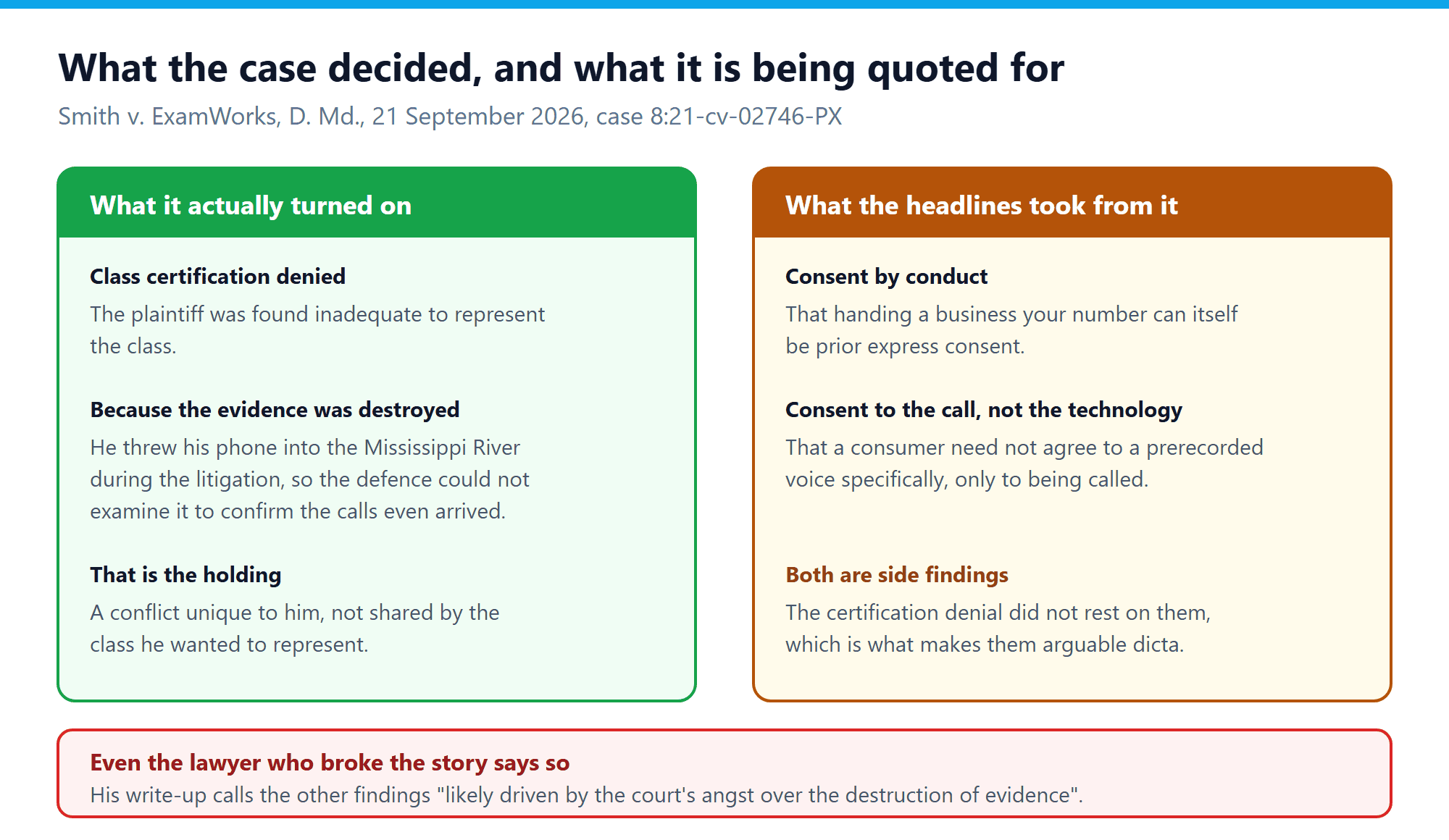
The court refused to certify the class. The reason given most attention in the write-ups is adequacy: to represent a class you have to show you are in the same position as its members, and this plaintiff was not, because at some point during the litigation he destroyed the single most important piece of evidence. With the handset gone, the defence could not examine it to establish who had been messaging him, what he had been doing, or even that the calls had landed on that phone at all.
Where the consent language comes in
Along the way the court made some observations that would help callers if they stand. One is that consent can be conveyed by conduct, so handing a business your phone number can itself amount to prior express consent. The other is the reading being quoted everywhere: that the statutory phrase about a call made with prior express consent attaches to the call, not to the use of a prerecorded voice. On that reading a consumer does not have to agree to the technology, only to being contacted.
That is genuinely interesting, and it may matter later. It is also not what the case was decided on. The certification denial did not rest on it, which is the textbook definition of a remark a later court is free to ignore.
The lawyer who broke the story is blunt about it himself. His write-up describes the court’s other findings as likely driven by its irritation at the destruction of evidence. When the person arguing your side says the reasoning was coloured by the plaintiff’s behaviour, that is a signal about how much weight it will carry.
Why we are not changing anything, and nor should you
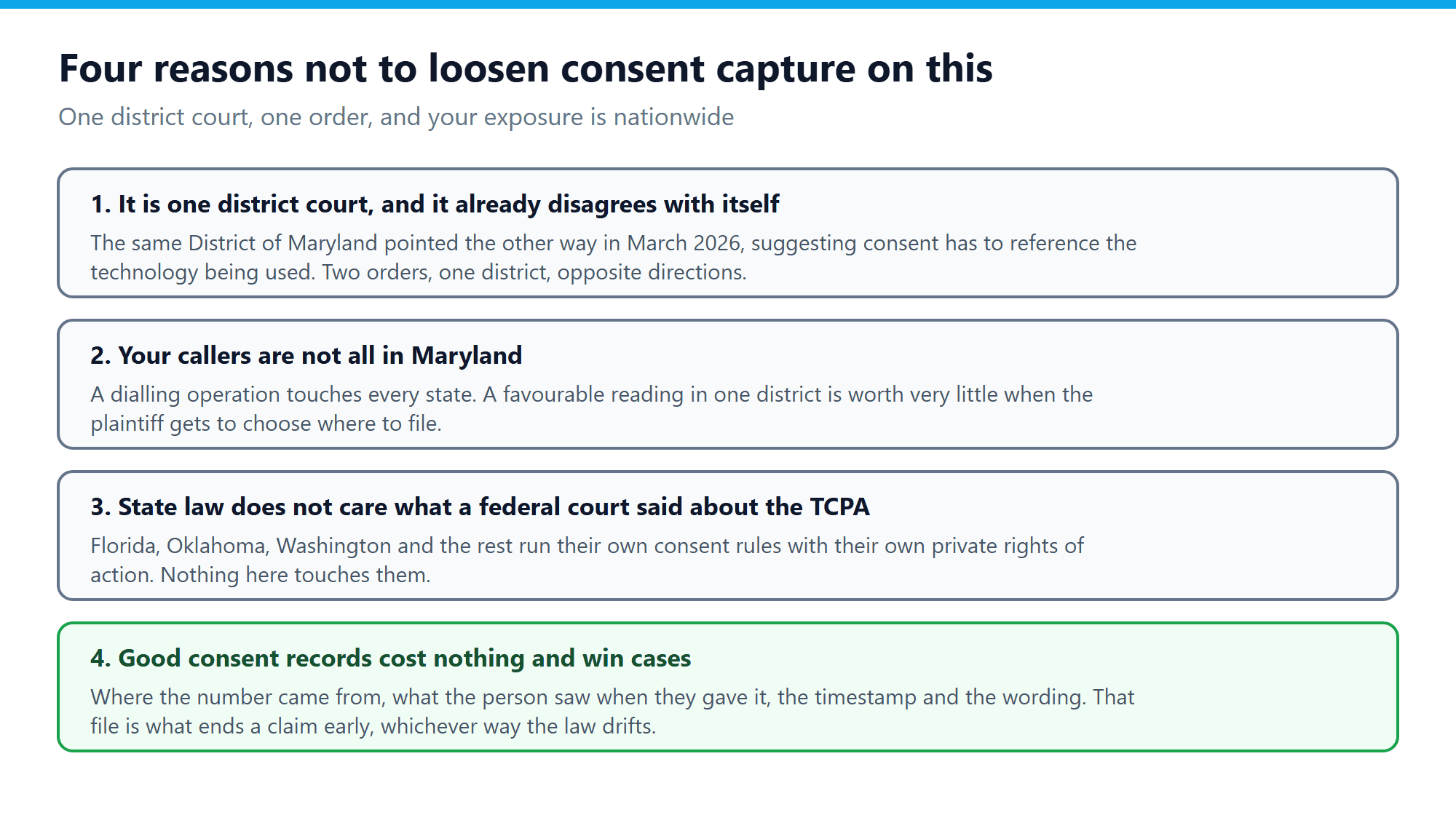
Start with the fact that the same district pointed the other way six months ago. A March 2026 decision in the District of Maryland suggested consent has to reference the regulated technology. Two orders, one courthouse, opposite directions, and no appellate ruling tidying it up. A split like that is a reason to sit still, not to move.
Then there is geography. A call center software operation places calls into every state, and the plaintiff picks the forum. A helpful reading in Maryland does nothing for you in a district that has never considered the question.
State law is the third problem, and the one people forget. Florida, Oklahoma and Washington run their own telemarketing statutes with their own consent standards and their own private rights of action. A federal court’s reading of the TCPA does not move any of them. Plenty of operators who are clean federally have been sued under a state statute instead.
And this is also single-source for now. One specialist blog has written it up, in two posts on the same day. That is not a criticism of the reporting, it is a statement about how much confirmation exists. Before rebuilding a consent flow on the strength of it, wait for other lawyers to read the order.
What is actually worth doing this week
The useful lesson in this case is not about consent at all. It is that the defence won because it could point at missing evidence, and the plaintiff lost because the record was gone.
That cuts both ways, and your side of it is the consent file. For every number you dial you want to be able to produce where it came from, what the person was looking at when they gave it, the exact wording they agreed to, and the timestamp. Not a flag in a column saying consent equals yes, but the underlying record.
Three things make that real in a dialling platform:
- Store the form as it appeared, not just the answer. Consent language changes. If you cannot show what the page said in March, you cannot prove what somebody agreed to in March.
- Keep the provenance with the record. Numbers arrive from web forms, imported lists, partner feeds and inbound calls, and those carry very different weight. Merge them into one field and you have thrown away the distinction a court will ask about.
- Retain long enough to survive the limitation period. A four year old claim needs a four year old record. Retention policies written for storage cost tend not to account for that.
None of that depends on how this consent question resolves. It is what turns a lawsuit into an early exit regardless of which way the reading goes.
Frequently asked questions
Does this mean giving out my number is now consent to robocalls?
No. One district court suggested it might be, in a case decided on other grounds, and another judge in the same district suggested otherwise earlier this year. Nothing has changed about what you are required to do.
Is the ruling binding anywhere?
District court decisions bind nobody, not even other judges in the same district. They carry persuasive weight, and a point the decision did not rest on carries less of it again.
Should we stop asking for technology-specific consent?
No. Asking somebody to agree to prerecorded or automated calls costs you a line of text and removes an argument. Dropping it to chase a favourable reading that might not survive is a poor trade.
What about informational calls like appointment scheduling?
That was the setting here, and informational calls have always had a different consent posture from marketing. The distinction is worth keeping clear in your campaign configuration, because it decides what a revocation covers.
How long should consent records be kept?
Long enough to cover the limitation period for every claim you could face, federal and state, which is longer than most retention defaults. Work backwards from the longest one that applies to you.