
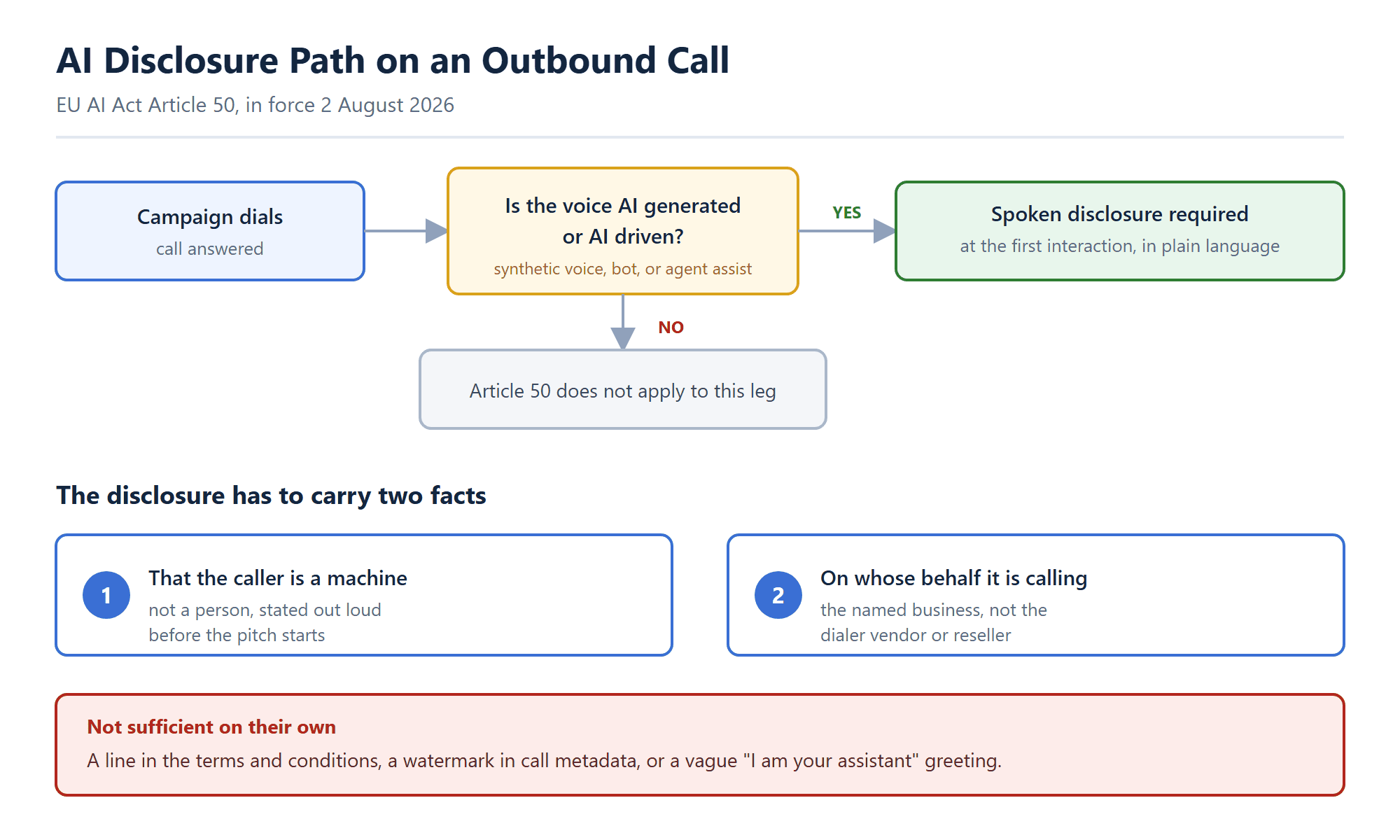
Since 2 August 2026, an AI voice calling into the EU has to announce itself. Article 50 of the EU AI Act asks for a spoken, plain-language disclosure at the first interaction, covering both the fact that the caller is a machine and the business it calls for. For call center software teams, that is a configuration job, not a legal memo.
What Article 50 actually asks for
The obligation is short, which is exactly why it slips past people. If a person interacts directly with an AI system, they have to be told. On a phone call, that means audio, at the start, in words a caller understands without hiring a lawyer.
Two facts have to land. First, that the caller is a machine. Second, on whose behalf it is calling. A watermark buried in call metadata does not clear the bar. Neither does a clause in your terms of service, which nobody hears while a phone is ringing. My honest read is that the second half will catch more operators than the first, because resellers and white-label teams habitually name the platform instead of the client whose campaign is running.
Penalties reach 15 million euros or 3% of worldwide annual turnover, whichever is higher. There is a separate December 2026 deadline for certain content-marking duties, but the phone disclosure date did not move with it.
The uncomfortable number sitting behind the rule
A 2026 blind study found that 71% of callers could not reliably tell an AI voice agent from a human. That single figure is most of the justification for Article 50. Back when synthetic speech was obviously synthetic, disclosure was redundant. It stopped being obvious somewhere around the point where end-to-end response latency dropped into the 250 to 800 millisecond band and the pauses started sounding like someone thinking.
Volume moved too. Voice AI went from 6% of inbound contact center traffic in 2024 to 19% in 2026, with banking and telecom leading. Regulators do not write disclosure rules for fringe use cases.
Where this breaks in a real dialer setup
Picture a twelve-seat outbound team running EU campaigns. A bot qualifies, a human closes. The bot discloses and the human does not need to, which sounds simple until the same audio prompt gets reused on a campaign where a person is doing the dialing. Now you have a recording announcing an automated system on calls that are not automated. Wrong in the other direction, but still wrong.
Language is the second trap. Plain language means the caller’s language, not yours. One English prompt on a campaign dialing Belgium and Poland does not satisfy anything, and this is the failure I would expect to see most often in audits over the next year.
Placement is the third. “At the first interaction” is not a synonym for “somewhere in the first minute.” If your script opens with a two-sentence hook and discloses afterwards, the interaction already happened. Answering machine detection complicates this further, because a disclosure that fires before detection resolves ends up on voicemail, and a disclosure that fires after it may land several seconds into a live conversation. Pick the order deliberately rather than inheriting whatever the flow does by default.
The FCC is walking the same road, just slower
US operators are not exempt from this thinking. The FCC ruled back in February 2024 that calls using AI-generated voices count as “artificial” under the TCPA, which pulls them under prior express written consent. A final rule dealing specifically with AI-generated calls is expected around Q4 2026 or Q1 2027, though the Commission under Chairman Carr has signaled a lighter regulatory posture than the previous one.
The likely shape is familiar: an explicit AI identification requirement at call open, consent language that names AI directly, and a formal definition of an AI-generated call. That overlaps enough with Article 50 that building two separate implementations would be wasted effort. Build one, then relax it per region if the FCC lands somewhere softer.
The money is not theoretical. TCPA class actions in 2025 and 2026 have settled in the $5M to $20M range, and statutory damages sit at $500 to $1,500 per unauthorized call. If your team is still working through the basics here, our guide to autodialer laws and TCPA compliance covers the consent side that these AI rules attach to. Teams dialing across borders should also read the country-wise auto dialer regulations before assuming one script works everywhere.
Proving it happened, six months later
This is the part almost everyone underinvests in. A complaint lands long after the campaign has been archived, and “we configured it correctly” is not evidence of anything. What you need is a call record that can be read back by someone hostile.
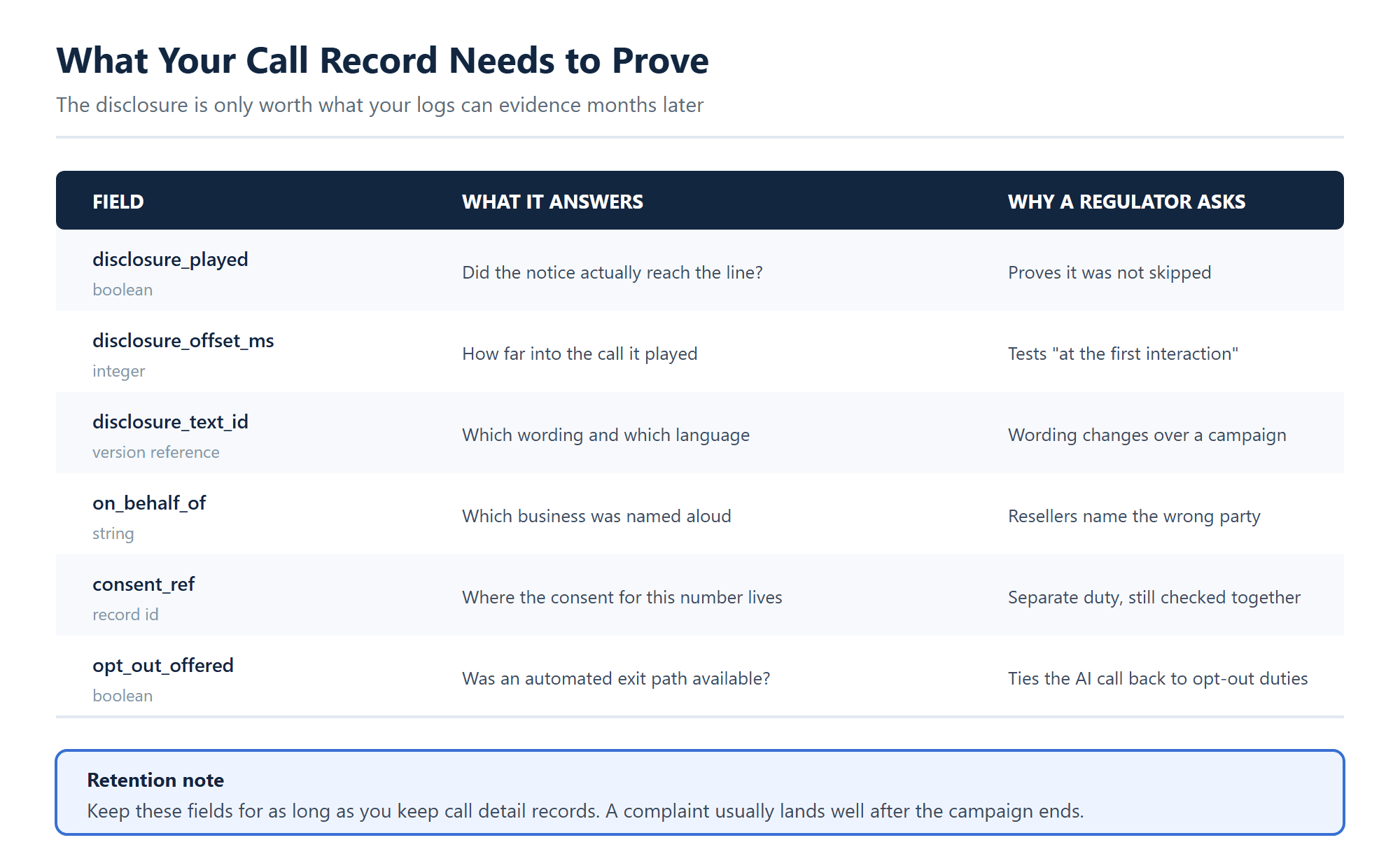
If you only add one field, make it the offset. Whether the disclosure played at all is usually easy to establish from audio. When it played, relative to the first word of the conversation, is the thing that actually gets argued about. Keep these fields for as long as you keep call detail records generally, because the complaint window outlasts the campaign by a wide margin.
One more practical note: version your disclosure text. Campaign wording changes mid-flight more often than teams admit, and a log entry pointing at “the standard disclosure” is useless if the standard disclosure was edited twice in March.
Doing this in ICTBroadcast
ICTBroadcast integrates with Google Dialogflow for building conversational agents, so the disclosure does not need a separate compliance module. It belongs in the call flow, ahead of the handoff. A few things worth setting up deliberately:
- Place the disclosure as the first prompt in the IVR flow, before control passes to the Dialogflow agent, so it always precedes the first conversational turn.
- Keep one prompt per language and bind it to the campaign’s target country rather than to a global default.
- Run AI campaigns as their own campaigns, separate from plain voice broadcast lists, so the opening prompt cannot leak onto human-dialed calls.
- Name the client business in the prompt text, not the platform. If you resell, this needs to be a per-tenant value, not a shared one.
- Export call detail records with the campaign identifier attached so the disclosure version can be reconstructed later.
None of this is heavy engineering. It is an hour of prompt work and a decision about where the boundary between bot and agent sits.
A short checklist before your next EU campaign
- Does the disclosure play before the first substantive sentence, not after it?
- Does it name a business, and is that business the client rather than the dialer vendor?
- Is there a prompt in every language the campaign targets?
- Does answering machine detection run before or after the disclosure, and did you choose that on purpose?
- Can you pull a call from four months ago and show when the disclosure played?
- Is the AI campaign isolated from lists that humans dial?
Frequently asked questions
Does Article 50 apply if a human agent uses AI assistance during the call?
The trigger is direct interaction between a person and an AI system. A human agent reading AI-suggested text to a caller is not the caller interacting with the AI. A synthetic voice speaking to the caller is. The grey zone is real-time voice cloning of an agent, and I would disclose in that case rather than argue about it later.
Do we need consent as well as disclosure?
They are separate duties and both apply. Article 50 governs transparency. Consent for the call itself comes from other law, and in the US the TCPA requires prior express written consent for AI-voiced marketing calls regardless of what you announce at the start.
What if the caller hangs up during the disclosure?
That is a compliant outcome, not a failure. Log it as a disclosure played with an early disconnect. Teams sometimes try to shorten the notice to reduce these drops, which is the wrong optimisation to run.
Does this apply to inbound calls too?
Yes. The obligation follows the interaction, not the direction of dialing. An inbound AI receptionist handling EU callers needs the same spoken notice at the top of the call.
We only dial the US. Can we ignore this?
For now, mostly. But the FCC rule expected in late 2026 or early 2027 points in the same direction, and retrofitting disclosure into a live campaign under deadline is worse than building it now. Most teams we talk to are treating the EU wording as the template.
Is a disclosure needed on every call in a campaign, or once per contact?
Per call. There is no concept of a caller remembering last week’s notice, and building that assumption into your flow creates a record you cannot defend.
Related resources
- Autodialer laws and regulations: TCPA compliant auto dialer
- Country-wise regulations about auto dialers
- Press 1 campaigns for interactive voice broadcasting
- IVR features in ICTBroadcast
- Free Asterisk based auto dialer
Getting this configured
If you are running EU campaigns and want the disclosure wired into the flow properly rather than bolted on, take a look at what ICTBroadcast ships with, and at the edition comparison if you need the Dialogflow integration specifically. Questions about a particular campaign setup are best raised through our support portal, where they reach the engineering team directly.