
On 20 November 2026 the FCC ordered an Egypt-based call center to answer 21 requests within 30 days, after it ignored a subpoena about 57 million calls. The order, DA 26-1247, doubles as a checklist. It shows exactly what investigators ask an outbound operation to prove, and how much of that proof should already sit in your call center software.
Most outbound teams think about compliance as rules: who you can call, when, and with what consent. This order is about something more practical. When the FCC comes asking, can you hand over the records? TeleTarget couldn’t, or wouldn’t, and that silence became its own violation. Reading the list of what the FCC now wants is the cheapest audit you’ll run this year.
What the FCC ordered on 20 November
The Enforcement Bureau’s Telecommunications Consumers Division issued a Citation and Order to TeleTarget LLC, which also does business as Investorfuel. According to the order, it’s a Wyoming company formed in 2024 with a Miami Beach mailing address, but it runs a business process outsourcing (BPO) call center in Egypt. FCC staff checked the Florida address and found a mail-receiving company, not TeleTarget. The company markets itself as a lead generation business with “expert cold-calling services” for real estate investors.
The investigation started with consumer complaints to the FCC and FTC about unwanted calls offering to buy people’s homes. Here’s how the trail ran, based on the order:
- Traceback. The Industry Traceback Group followed several of those calls back to a voice provider, AM Communication Labs, which named TeleTarget as the customer behind them.
- The provider’s records. The FCC subpoenaed AM Communication on 27 June 2025. Its call detail records showed TeleTarget placed 57,371,168 calls between 31 January and 16 June 2025. That’s more than 400,000 calls a day on average, by our arithmetic.
- The call center’s silence. The FCC emailed TeleTarget in January 2026, then served a subpoena on its Wyoming registered agent on 16 January. The response was due 27 January. As of 20 November, nothing had come back.
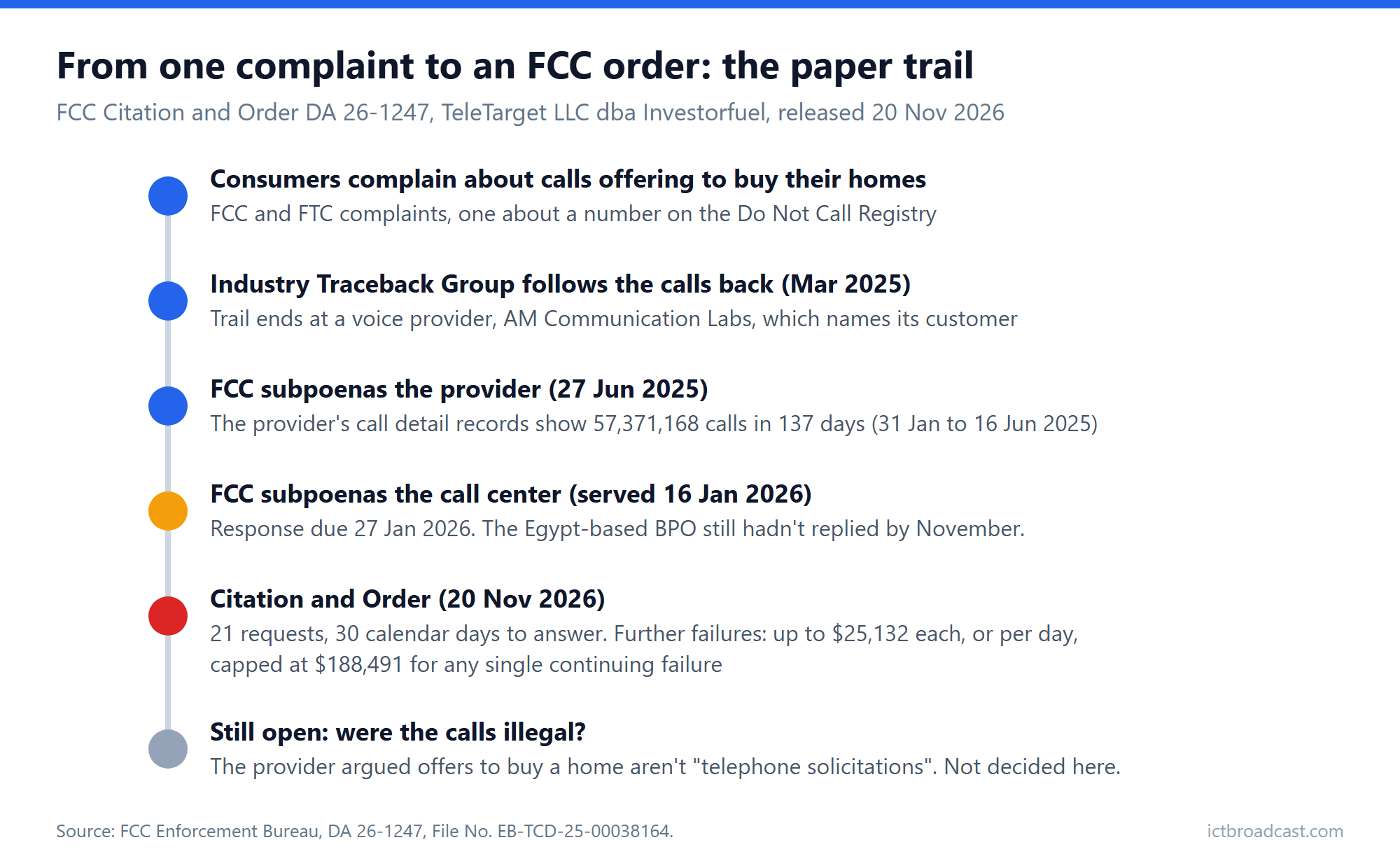
A citation isn’t a fine. TeleTarget doesn’t hold an FCC license, so the Communications Act requires the agency to warn it first. If it fails to comply again, including with the new order, it faces up to $25,132 for each violation or each day of a continuing violation, capped at $188,491 for any single continuing failure. The response window runs 30 calendar days from release, which puts it at 20 December.
The legality question nobody has settled yet
Here’s the detail most coverage skips. AM Communication told the FCC the calls weren’t illegal at all. Its argument, citing two 2025 federal district court decisions, was that an offer to buy someone’s home isn’t a “telephone solicitation”, because the FCC’s rule defines that as a call encouraging the purchase or rental of, or investment in, property, goods or services.
The citation doesn’t decide that point. It cites TeleTarget for one thing only: ignoring a subpoena. The order also notes that some home-buying calls offer real estate services for a fee, and several complaints it quotes describe prerecorded messages. Those raise different rules again. So if you run home-buyer campaigns, don’t read this as a ruling that you’re safe or that you’re exposed. Read it as a sign that the FCC is investigating the category anyway, and that it will ask for your records whatever the final legal answer turns out to be.
The 21 requests, and how many your call center software can answer
Section VI of the order lists what TeleTarget must produce. We’ve sorted the 21 items by where the answer would actually live in a typical outbound operation. The split is the useful part.
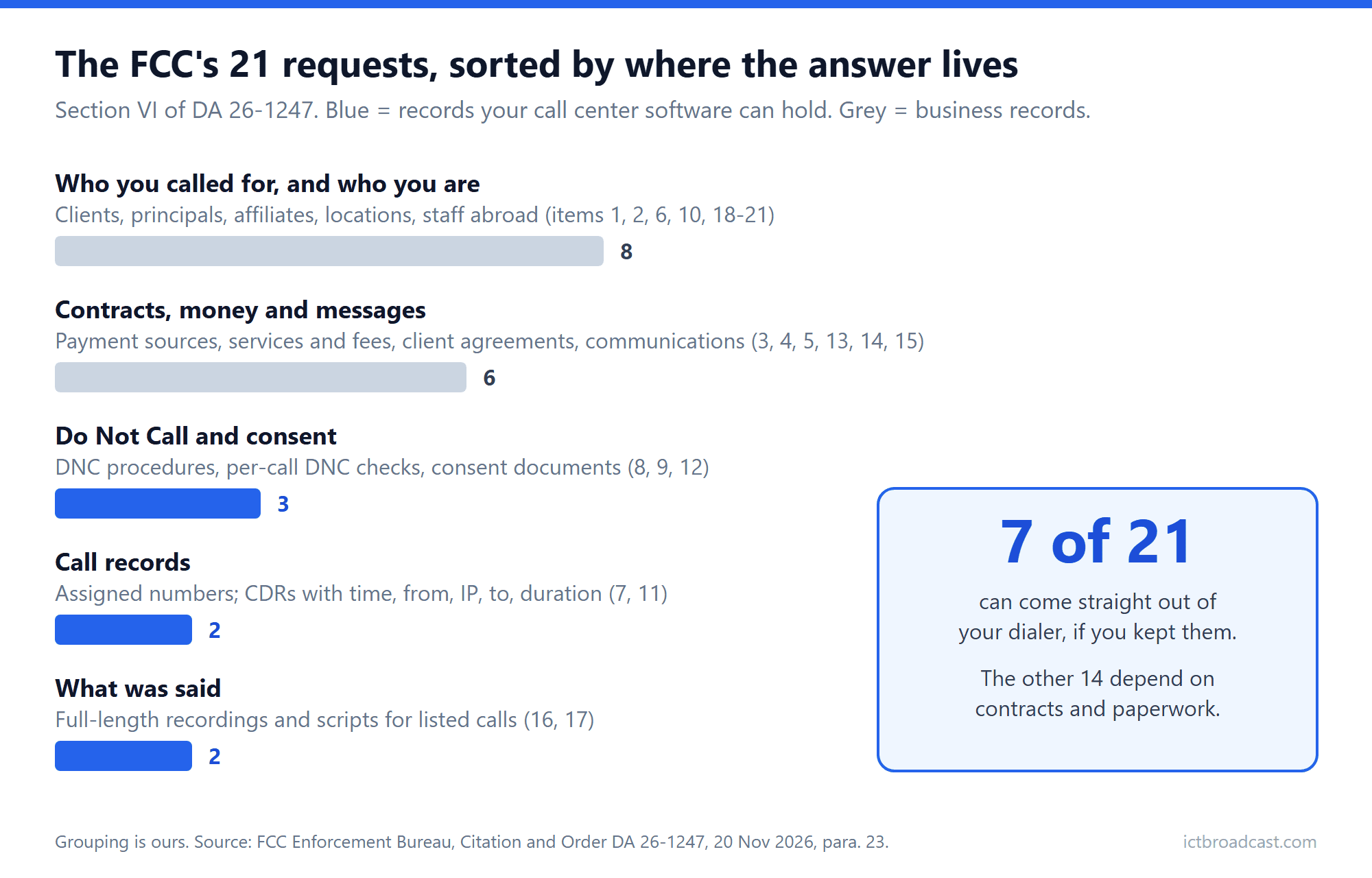
Fourteen of the requests are business paperwork: who your clients are, how they paid you, what services you sold them, your contracts, your emails, your officers, your affiliated companies, and in this case every location and every person working from Egypt. No dialer holds that for you. If your client contracts live in someone’s inbox, that’s the first thing to fix.
The other seven are records your call center software should be able to produce, if you kept them:
- Call detail records. The FCC defines these as the date and time, the calling number, the IP address associated with the call, the number called and the duration.
- Numbers assigned to you. Every telephone number you used or were given in the period.
- Do Not Call procedures, both in general and for each specific call the FCC lists.
- Consent documents for the listed calls.
- Full-length audio recordings of each listed call.
- The scripts used on each listed call.
Our view is simple. If you can’t produce those seven within a week, your problem isn’t a regulator. It’s your setup.
How ICTBroadcast maps to the seven
We’d rather be specific than promise compliance in a box, so here’s what the product actually does against each record type. ICTBroadcast is Asterisk-based call center software, and you can run it on your own server or as a cloud instance. Either way the records below are generated as campaigns run.
Call records. The CDR report lists every call with date, time, campaign, contact, dialed number, duration, call status, disposition and a recording link, filterable by date, campaign, agent and status, and exportable to CSV. The Report Builder lets you save a custom CDR query, so the FCC’s “every call in this date range” request becomes a saved report, not a weekend project. Two of the FCC’s fields need a second look: the calling number is the caller ID you set on each campaign, and the IP address of the call path is something to confirm with your SIP carrier, so check you can get it from them.
Do Not Call. ICTBroadcast keeps two lists, a Master DNC for national registry numbers and a User DNC for each tenant’s own opt-outs. Campaigns check against them before dialing, a DNC opt-out key lets a called person remove themselves mid-call, and an IVR node can add the caller to the list from inside a flow. That’s your answer to item 8. Item 9 is harder, because it asks how you complied for each listed call, which means showing which registry copy was loaded on the day. Keep dated copies of every registry download you load.
Recordings and scripts. Recording can be switched on for a whole campaign or started selectively with the Call Record node in an IVR, and the Call Recording report lists each recording with agent, campaign, contact and date. Agents see the campaign script on the same screen as the contact during a live call. Don’t count on any dialer to keep a dated history of every script version, though. When you change a script, save the old one with the dates it was live.
Consent. This is the weakest link for most teams, and no dialer fixes it alone. If your leads come from a vendor, the consent record usually lives with them. Get the consent source and timestamp for every contact when you import it, store it in one of the contact’s custom fields, and make sure your vendor contract says you can get the underlying proof within days.
A tenant per client answers the first question
The FCC’s very first request is “identify the person on whose behalf each call was made”. For a BPO calling for dozens of investors from one shared setup, that can be close to impossible to reconstruct. ICTBroadcast is multi-tenant, with each user account seeing only its own campaigns, agents and reports. If you’re a BPO or a reseller, give every client its own tenant. Then the on-whose-behalf question is answered by the account the call came from, and you can export one client’s records without touching anyone else’s. Service providers on the SP Edition also get the REST API included, which helps if you’d rather pull CDRs into your own archive on a schedule.
Why foreign call centers should read this twice
The order goes out of its way to connect TeleTarget to the FCC’s onshoring proposal from March 2026, which floats limits and disclosure duties for offshore customer service operations. We covered that proposal in our post on FCC offshore call center rules. It’s still a proposal, published in the Federal Register in April with no final rule yet. But the order quotes the Commission’s own line that “there are a whole host of call centers overseas that are being used to flood America and our citizens with illegal robocalls.”
Two lessons follow if your agents sit outside the US. First, a US shell address doesn’t shield you. The FCC served the Wyoming registered agent, and confirmed with the building’s management that the company wasn’t at its Florida office. Second, the trail almost always starts at your carrier. AM Communication answered its subpoena and handed over CDRs naming its customer. That’s the same chain we described when the FCC cut off eight providers for ignored tracebacks: your carrier will protect its own listing before it protects you.
A 30-day drill you can run now
Pick one campaign from last quarter and pretend the FCC just sent you this order. Then time yourself:
- Export every CDR for that campaign and check each of the FCC’s five fields is there or obtainable from your carrier.
- Pull ten random calls and find the recording, the script that was live that day and the consent record for each contact.
- Show which DNC list version was loaded when those ten calls went out.
- Name the client the campaign ran for and find the signed agreement.
If any step takes more than a day, you’ve found your gap, and you found it before anyone else did. That’s the whole point of the exercise.
Frequently asked questions
What is FCC Citation and Order DA 26-1247?
It’s an FCC Enforcement Bureau action released on 20 November 2026 against TeleTarget LLC, dba Investorfuel, a Wyoming company running a call center in Egypt. It cites the company for ignoring a subpoena about home-buying calls and orders it to provide 21 sets of information and documents within 30 calendar days.
Was TeleTarget fined?
Not yet. Because it holds no FCC license, the law requires a citation first. If it fails to comply with a Commission order again, it can face up to $25,132 for each violation or each day of a continuing violation, up to $188,491 for any single continuing failure.
Are calls offering to buy a home telephone solicitations?
That’s disputed. The provider argued they aren’t, citing two 2025 district court decisions, because the rule covers calls encouraging people to buy, rent or invest. The citation doesn’t resolve the question, so get legal advice before relying on either view.
What call detail records does the FCC ask for?
The order defines call detail record information as the date and time of the call, the number it was placed from, the IP address associated with it, the number called and the duration. It asked TeleTarget for every call from 1 July 2026 to the present.
Can ICTBroadcast export call records for an investigation?
Yes. The CDR report covers date, time, campaign, contact, dialed number, duration, status, disposition and recording link, and exports to CSV. The Report Builder saves custom CDR queries. Confirm with your SIP carrier how you’d get the IP data for the call path.
Does a US company address protect an offshore call center?
No. In this case the FCC served the subpoena on the company’s Wyoming registered agent and confirmed the company wasn’t at its listed Florida office. The order then noted the offshore call center concerns behind the FCC’s March 2026 onshoring proposal.