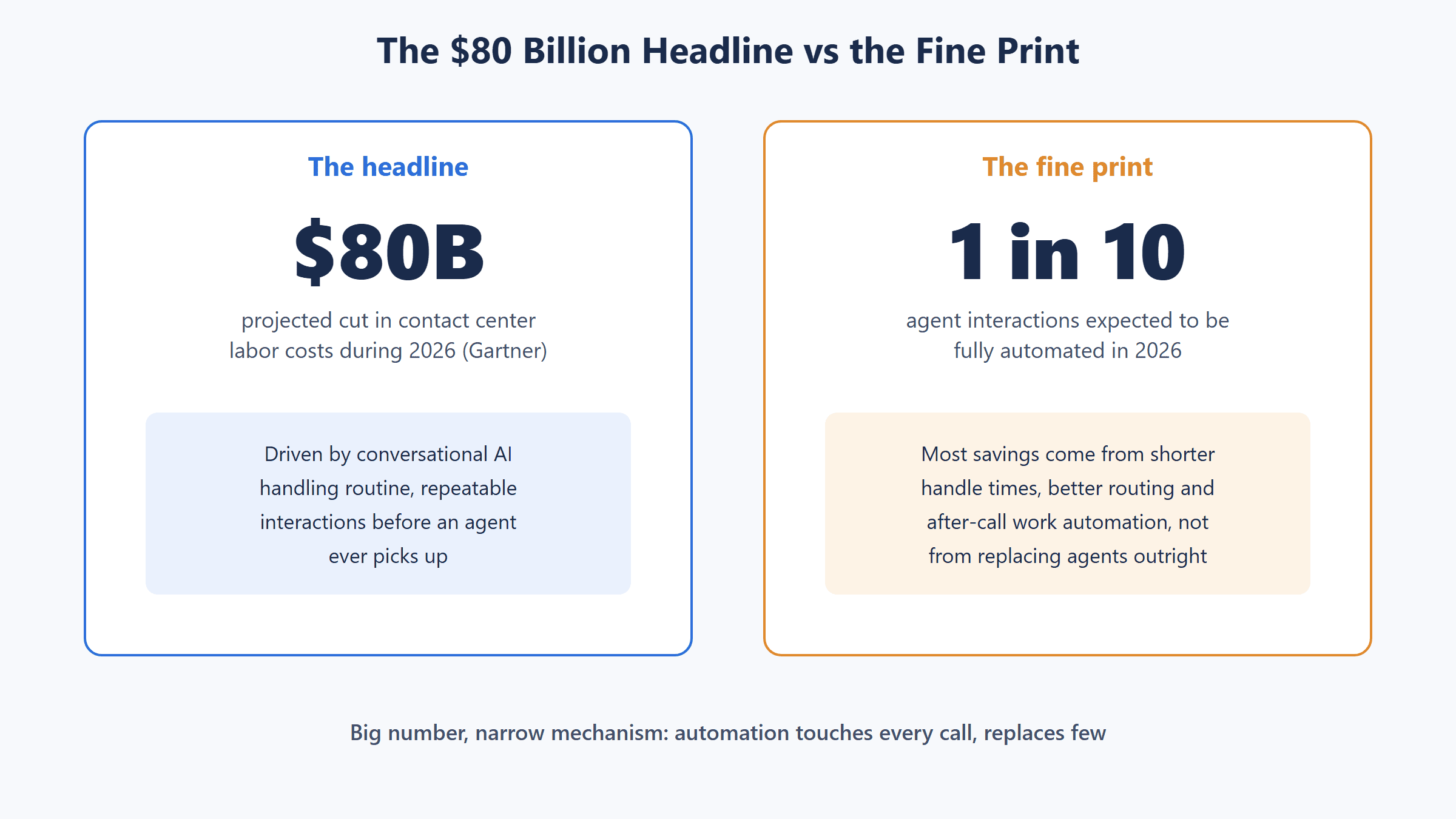
Gartner’s projection made headlines across the industry this month: conversational AI will trim contact center labor costs by $80 billion during 2026. Impressive number. The same research carries a detail most coverage skipped, and it changes what the figure means for anyone running call center software: only about one in ten agent interactions will be fully automated this year.
So nine out of ten calls still need a person. Where does $80 billion come from, then? That gap between the headline and the mechanism is worth understanding before you sign anything, because vendors will quote you the big number while selling you the narrow slice.
Where the Call Center Software Savings Actually Come From
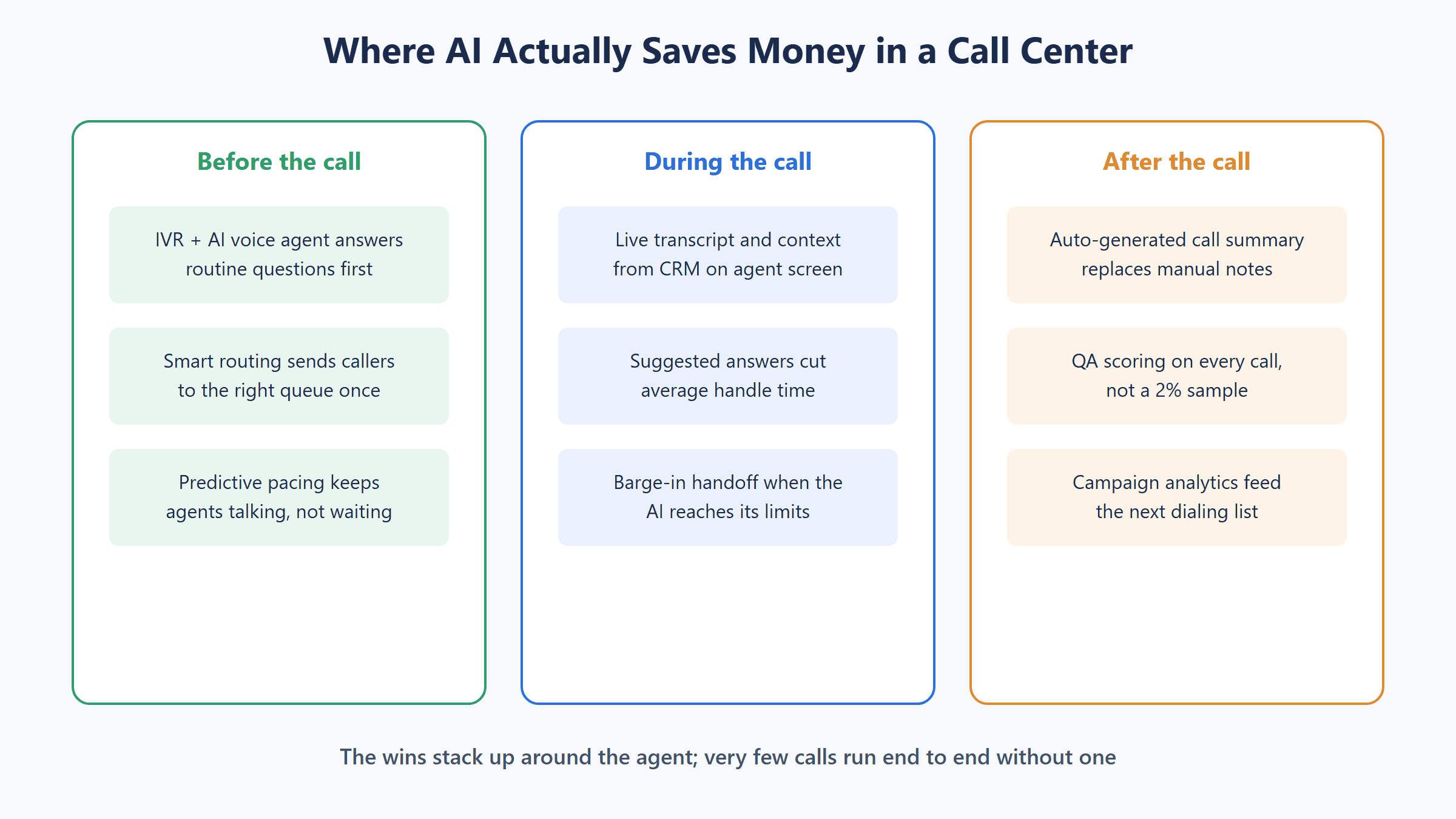
Full automation gets the attention, but it’s the smallest contributor. The savings pile up in less glamorous places. Shorter handle times account for a big share: when an agent gets a live transcript, caller history, and a suggested answer on screen, a six minute call becomes a four minute call. Multiply that across a 50 seat floor and you’ve cut the equivalent of a dozen positions without automating a single conversation end to end.
After-call work is the second quiet winner. Agents have historically spent 30 to 60 seconds per call typing notes. Auto-generated summaries wipe most of that out. Then there’s QA: instead of a supervisor sampling 2% of calls, AI scoring covers every call, which means coaching happens where it’s needed rather than where the sample happened to land.
The mid-market reality check matters here. The contact center AI market hit roughly $4.89 billion this year, and enterprises like Cigna and Comcast are running voice AI at serious scale. But those firms have data teams tuning the systems weekly. If you run a 20 seat operation, your savings come from the assistive layer first, and I’d argue that’s the right place to start anyway.
What This Means for Outbound Campaigns
Most of the AI coverage focuses on inbound support, but outbound teams have their own version of this math. Predictive pacing is decades old and still delivers the single biggest efficiency gain in outbound calling: agents talk instead of waiting for someone to answer. Layer AI on top and the picture improves further. Answering machine detection gets sharper, so fewer agent seconds burn on voicemail. Campaign analytics tell you which lists, scripts, and time windows convert, so tomorrow’s dialing plan is better than today’s.
You don’t need a Fortune 500 budget for any of that. An Asterisk based auto dialer paired with sensible campaign design captures most of the assistive-layer gains at a fraction of the licensed-seat pricing the big CCaaS vendors charge. The honest answer is that the software matters less than the discipline: track connect rates, listen to failed calls, and adjust weekly.
The One-in-Ten Rule Should Shape Your Buying
Here’s the practical takeaway. If a vendor pitch centers on replacing agents, be skeptical: the research says that slice stays small through 2026. If the pitch centers on making each agent 20 to 30 percent more productive, the numbers back it up.
That framing also protects you from overbuying. Voice AI minutes, LLM API fees, and per-seat AI add-ons stack quickly. Start with what pays back fastest: automated summaries, full-coverage QA, smarter routing, and voice broadcasting for the messages that never needed a live agent in the first place. Appointment reminders, payment notices, and service alerts are automation that has worked for years, no LLM required.
Then pilot one AI voice agent use case with clear exit criteria. Measure containment and the 7 day recontact rate, not just deflection. A deflected call that comes back angry tomorrow saved you nothing.
FAQ
Will AI replace call center agents in 2026?
Not at any meaningful scale. Gartner expects only about one in ten agent interactions to be fully automated in 2026. The bigger effect is assistive: AI shortens calls, automates notes, and covers QA, which changes how many agents you need per thousand calls rather than eliminating the role.
Where does call center AI save the most money?
Handle time reduction, after-call work automation, and full-coverage QA scoring deliver the most reliable savings. Full call automation helps for narrow, high-volume intents like order status or appointment confirmation, but it’s the smallest slice of the total.
Can small call centers benefit from AI without enterprise budgets?
Yes. Open source call center software with predictive dialing, answering machine detection, and campaign analytics captures most of the productivity gain. Add AI summaries and QA scoring through affordable APIs rather than per-seat platform fees.
What should I measure in an AI voice agent pilot?
Containment rate, escalation quality, and the 7 day recontact rate. If callers the AI “resolved” call back within a week, the automation moved the work instead of removing it.
Is voice broadcasting still relevant when AI voice agents exist?
Very much so. One-way notifications like reminders and alerts don’t need conversational AI, and broadcasting them costs a fraction of an interactive AI call. Use the cheap tool where the job is simple.